
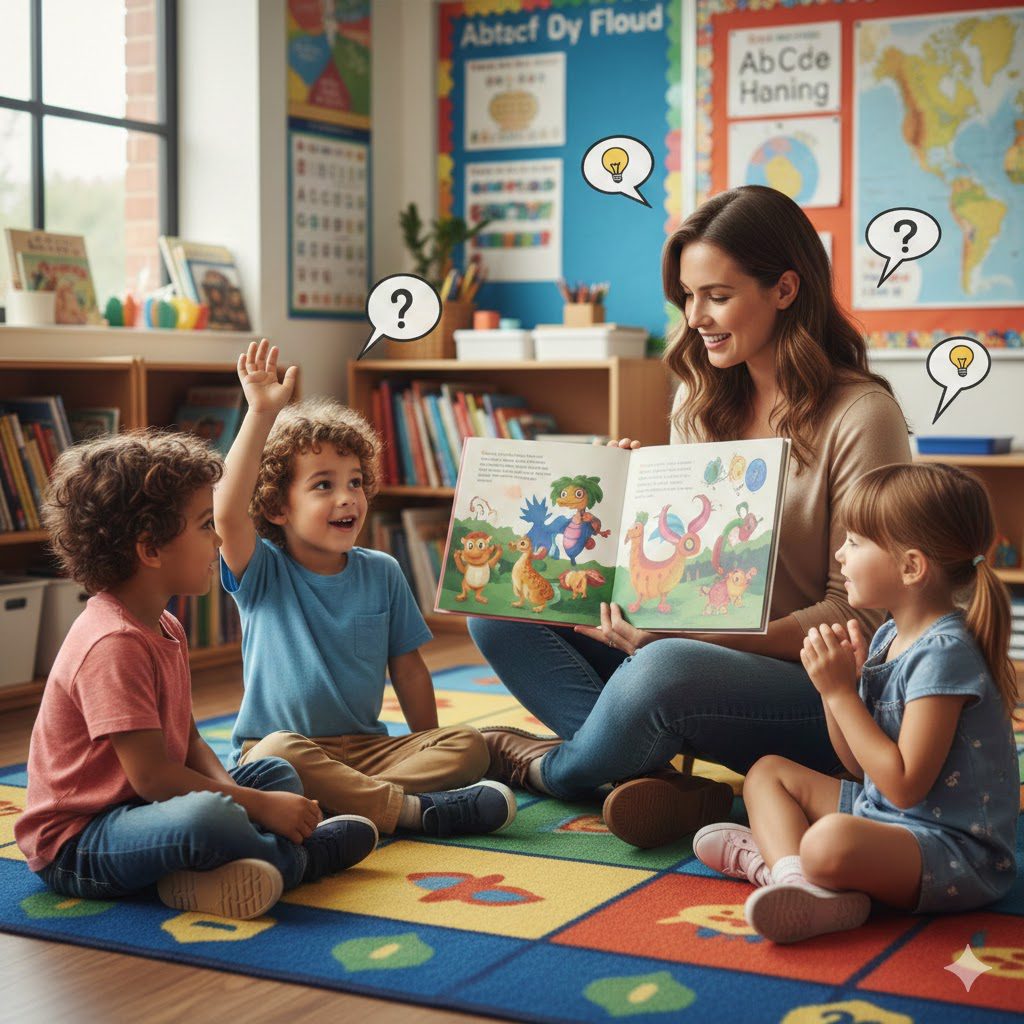
Interactive Read Alouds: Discover the benefits for your kids


Reading aloud to children has always been a cornerstone of early literacy development. It fosters a love of books, builds vocabulary, and introduces children to new worlds and ideas. However, the traditional model of a teacher simply reading a story while children passively listen often falls short of its full potential. Enter interactive read alouds – a dynamic approach that transforms story time into an engaging, participatory experience, maximizing learning and deepening comprehension.
- Table of Contents
- The benefits of interactive read alouds
- Interactive read alouds inspire to read books
- Frequently Asked Questions about Interactive Read Alouds
Interactive read alouds are more than just reading; they are carefully planned lessons where the teacher thoughtfully selects a book and strategically pauses during the reading to engage children in discussions, ask open-ended questions, and encourage predictions. The goal isn’t just to get through the story, but to delve into its layers, explore its themes, and connect it to the children’s own experiences. This active engagement helps children develop critical thinking skills, infer meaning, and articulate their thoughts, making them active participants in the storytelling process.
The benefits of interactive read alouds
One of the most significant benefits of interactive read alouds is their ability to build vocabulary and language comprehension. During the reading, teachers can highlight new or challenging words, explain their meanings in context, and encourage children to use them. For instance, when encountering a word like “gigantic,” a teacher might ask, “What do you think ‘gigantic’ means based on the picture?
Can you think of something else that’s gigantic?” This contextual learning is far more effective than simply being told a definition, as it helps children integrate new words into their existing knowledge framework.
Beyond vocabulary, interactive read alouds cultivate a deeper understanding of narrative structure and character development. By pausing to ask questions like, “What do you think the character will do next?” or “Why do you think the character feels that way?”, children learn to analyze the plot, predict outcomes, and empathize with characters.
They begin to understand cause and effect, problem and solution, and the emotional arcs within a story. This kind of analytical thinking is crucial not only for literacy but for overall cognitive development.
Another powerful aspect of interactive read alouds is their capacity to foster a sense of community and shared experience within the classroom. When children discuss a story together, they learn to listen to different perspectives, agree and disagree respectfully, and build upon each other’s ideas. This collaborative environment strengthens social-emotional skills and creates a rich, inclusive learning space where every child’s voice is valued.
It transforms individual reading into a collective journey of discovery.
Implementing effective interactive read alouds requires preparation. Teachers need to select books that are rich in language, have engaging plots, and offer opportunities for discussion. Before reading, the teacher should preview the book, identify key vocabulary, pinpoint stopping points for discussion, and formulate open-ended questions that encourage higher-order thinking.
It’s not about asking questions on every page, but rather strategically choosing moments that will spark curiosity and critical engagement. The questions should go beyond simple recall, prompting children to make inferences, connections, and evaluations.
For instance, when reading a book about friendship, a teacher might pause and ask, “What makes a good friend?” or “Has anyone ever felt like the character in the story?” These types of questions encourage children to connect the story to their own lives, making the learning more personal and memorable.
The beauty of interactive read alouds lies in their flexibility and adaptability. They can be used across various age groups and tailored to different learning objectives, whether it’s exploring a specific theme, introducing a new concept, or simply fostering a love of reading.
Interactive read alouds inspire kids to read
Moreover, interactive read alouds are a fantastic tool for promoting print awareness and phonological awareness. As the teacher reads, they can explicitly point to words, track the text with their finger, and draw attention to letter sounds or rhyming patterns. This explicit modeling helps children understand the mechanics of reading and how print works, laying a strong foundation for independent reading skills. The visual and auditory connections made during these sessions are invaluable for emerging readers.
The magic of interactive read alouds extends beyond the immediate lesson; they instill a lifelong love of reading. When children experience stories in such an engaging and meaningful way, they are more likely to seek out books on their own and view reading as a source of pleasure and knowledge rather than a chore. It transforms reading from a passive activity into an exciting adventure, where their voices and ideas are an integral part of the journey. Ultimately, interactive read alouds are a testament to the power of shared stories and the profound impact they have on young minds.


Frequently Asked Questions about Interactive Read Alouds
What is the main difference between a traditional read aloud and an interactive read aloud?
The primary distinction lies in engagement. A traditional read aloud often involves a teacher reading uninterrupted, with children listening passively. In contrast, an interactive read aloud strategically incorporates planned pauses, open-ended questions, and discussions to actively involve children in analyzing the text, making predictions, and connecting to their own experiences, transforming them from listeners to active participants.
How do interactive read alouds support reading comprehension for diverse learners?
Interactive read alouds are highly effective for diverse learners because the verbal interaction and guided discussion provide scaffolds that support understanding. English language learners benefit from hearing new vocabulary in context and having opportunities to practice speaking about the story.
Students with learning differences can process information at their own pace through group discussions and explicit modeling of comprehension strategies, making the text accessible to a wider range of abilities.
What are some effective questioning strategies to use during an interactive read aloud?
Effective questioning goes beyond simple recall; it encourages deeper thinking. Teachers should use open-ended questions that prompt children to make predictions (“What do you think will happen next?”), infer meaning (“Why do you think the character felt sad?”), connect to personal experiences (“Has anything like this ever happened to you?”), and evaluate (“What lesson can we learn from this story?”). Focusing on “why” and “how” questions helps foster critical thinking and richer discussion.
Also read the following blog posts
Get the new Linkbuilding Guide to increase your Google ranking
Animal bedtime stories for kids review
A “Must-Have” for thriller fans. The secret of secrets by Dan Brown
How to find a cheap kindle ebook? – The eBookWorld24 shoppers guide
Delightful easter gift eBooks for all ages: eBookworld24’s best choices
Sources
Fisher, D., Frey, N., & Lapp, D. (2012). Text complexity: Raising rigor in reading. International Reading Association.
Ivey, G., & Fisher, D. (2005). When students don’t read what they should: Classroom activities that help. Journal of Adolescent & Adult Literacy, 48(7), 606-613.
Gambrell, L. B., & Almasi, J. F. (Eds.). (1996). Lively discussions! Fostering engaged reading. International Reading Association.